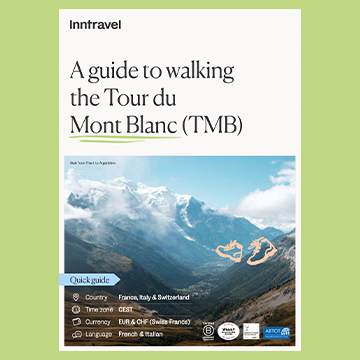
First things first, can you tell us a bit more about Grand Angle – who you are, what you do, and how you work with Inntravel?
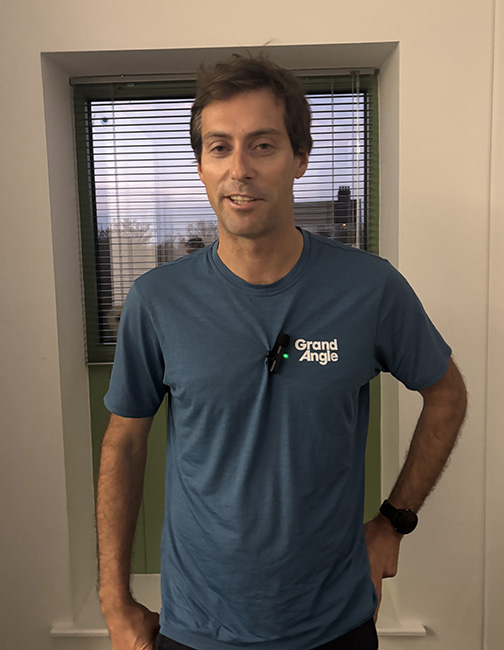 David: I’m David, and I’m the manager at Grand Angle, which is a French tour operator in the French Alps. It’s a family business that was set up by both of my parents in the 1980s. My brother and I took over from our parents 10 years ago, in 2016.
We started to work with Inntravel a couple of years ago with the Tour du Mont Blanc – which we’re operating alongside other tours in the French Alps, in the Aravis – and basically we’re in charge of booking all the hotels and the luggage transport, and we take care of the routing and making sure that hikers are safe on the trails.
Chris: I’m Chris, I work with Grand Angle. Basically, we’re sharing our 40 years of local knowledge with you so the holiday is the best it can be.
Why do you think the partnership between Grand Angle and Inntravel works so well?
David: I think it’s beneficial for us both. For us, it’s a pleasure to welcome your guests in France and on the Tour du Mont Blanc, and in return Inntravellers can benefit from our local connections with the hotels – it’s a win-win situation.
We have really close relationships with the hotels – we visit them multiple times a year to build that trust with them and ensure allocation (as the Tour du Mont Blanc is especially difficult to book) – and we have lots of clients and guides on the ground throughout the season if there are any issues.
It’s something that’s really needed, in my opinion, for both Inntravel to have a local partner and for the local partner to have Inntravel, because you know your guests and the people who want to walk with you, and we need to keep an open mind and try to be adaptable and flexible to your needs and what your guests would like. We build the trips together.
Chris: I think, with this being a family-run company, we see a lot of similarities with Inntravel – its growth and some of its philosophies. It feels like the same people – it feels like the same kind of family and the same kind of business ethics and that’s really nice.
It’s like a true collaboration towards the outcome of a trip. Partners can show us new things in our own backyard, as we bring them into the backyard to look deeper. It’s helpful to have new minds and new eyes come in and suggest things we hadn’t thought of – that’s really where that kind of real partnership, or real collaboration, comes in.
David: Grand Angle is kind of a small Inntravel. We have a very similar mentality and way of approaching things.
We have really close relationships with the hotels – we visit them multiple times a year to build that trust with them and ensure allocation (as the Tour du Mont Blanc is especially difficult to book) – and we have lots of clients and guides on the ground throughout the season if there are any issues.
It’s something that’s really needed, in my opinion, for both Inntravel to have a local partner and for the local partner to have Inntravel, because you know your guests and the people who want to walk with you, and we need to keep an open mind and try to be adaptable and flexible to your needs and what your guests would like. We build the trips together.
Chris: I think, with this being a family-run company, we see a lot of similarities with Inntravel – its growth and some of its philosophies. It feels like the same people – it feels like the same kind of family and the same kind of business ethics and that’s really nice.
It’s like a true collaboration towards the outcome of a trip. Partners can show us new things in our own backyard, as we bring them into the backyard to look deeper. It’s helpful to have new minds and new eyes come in and suggest things we hadn’t thought of – that’s really where that kind of real partnership, or real collaboration, comes in.
David: Grand Angle is kind of a small Inntravel. We have a very similar mentality and way of approaching things.
Why should customers book a holiday with Inntravel?
 Chris: Inntravel puts a lot of thought into the accommodation and the experiences – beyond the hiking. It’s the entire package, and I think that attention to detail is very impressive. I think that’s why you’re still getting returning guests after 40 years; they’re coming back because of the attention that is being put into everything, and they know that even a new trip is going to be as good as the ones you’ve been running for years.
Turning specifically to the French Alps and Annecy now, can you share more about why this area is so special?
David: For me, the French Alps feel incredibly authentic. You get this amazing combination of landscapes, with the highest mountains in Europe right there – it’s really impressive and breathtaking. At the same time, especially in the Aravis area, you’re hiking through very green pastures, with wide, open views almost everywhere you look.
You also really experience the traditional Savoyard culture. There’s the cheese, of course – Reblochon, Beaufort, Tomme de Savoie – and you pass by farms decorated with colourful medals from all the competitions their cows have won. They win a lot of contests over there, and it’s actually quite charming to see.
So it’s just great: the food, the scenery – everything comes together.
You also really experience the traditional Savoyard culture. There’s the cheese, of course – Reblochon, Beaufort, Tomme de Savoie – and you pass by farms decorated with colourful medals from all the competitions their cows have won. They win a lot of contests over there, and it’s actually quite charming to see.
So it’s just great: the food, the scenery – everything comes together.
Sounds amazing! Are there any other local delicacies?
David: So, the most famous cheese in the Aravis is Reblochon. It’s made from cow’s milk, and the best way to eat it is in a ‘tartiflette.’ A tartiflette is basically potatoes, bacon, and onions, topped with a whole Reblochon cheese. The cheese itself is quite big – around 16 to 20 centimetres in diameter.
You cut it in half, place it on top of the potatoes, put everything in the oven, and wait for it to melt. It’s rich and pretty heavy, but it’s really delicious. Normally it’s more of a winter dish, but it’s definitely the traditional one around here.
Chris: Speaking of food, if you go just one valley over, the bread will already be a little different. The cheese is made in a slightly different way too. You find so much variety, even in products that seem very similar, so you really feel that you’re in a highly specialised area, culturally.
The wine culture is interesting too. There’s good wine in the region, and there are mountain drinks made from local herbs.
David: Yes, in the Aravis, and in this part of the French Alps, they have a special drink that.png "Inntravel_Illustration_RGB_Charcoal_Wine-glasses-(1).png") is called ‘Génépi.’ It involves taking a flower that you pick in the mountains, at high altitude, that you add to alcohol. The recipe is usually 40 flowers, in 40% alcohol, and with 40 grams of sugar per litre, and you wait for 40 days for the flower to infuse the alcohol, which makes Génépi – the traditional alcohol in the French Alps. It’s usually what you get at the end of a dinner.
is called ‘Génépi.’ It involves taking a flower that you pick in the mountains, at high altitude, that you add to alcohol. The recipe is usually 40 flowers, in 40% alcohol, and with 40 grams of sugar per litre, and you wait for 40 days for the flower to infuse the alcohol, which makes Génépi – the traditional alcohol in the French Alps. It’s usually what you get at the end of a dinner.
You cut it in half, place it on top of the potatoes, put everything in the oven, and wait for it to melt. It’s rich and pretty heavy, but it’s really delicious. Normally it’s more of a winter dish, but it’s definitely the traditional one around here.
Chris: Speaking of food, if you go just one valley over, the bread will already be a little different. The cheese is made in a slightly different way too. You find so much variety, even in products that seem very similar, so you really feel that you’re in a highly specialised area, culturally.
The wine culture is interesting too. There’s good wine in the region, and there are mountain drinks made from local herbs.
David: Yes, in the Aravis, and in this part of the French Alps, they have a special drink that
is called ‘Génépi.’ It involves taking a flower that you pick in the mountains, at high altitude, that you add to alcohol. The recipe is usually 40 flowers, in 40% alcohol, and with 40 grams of sugar per litre, and you wait for 40 days for the flower to infuse the alcohol, which makes Génépi – the traditional alcohol in the French Alps. It’s usually what you get at the end of a dinner.
Any stand-out hotels or hoteliers in the Aravis, Rebecca?
Rebecca: The hotel in Chinaillon, Hotel l’Alpage, which is the second hotel on our Annecy holiday – they were really lovely. It very much had a home-away-from-home feel because the owners were very involved and keen to chat. I watched them chatting with Grand Angle customers and finding out where they’d been for the day, their plans for the next day, and so on. The food was really good, and the view was really lovely.
Do you have any hidden gems in the area to recommend?
Chris: Walking the streets of Annecy is pretty special.
David: Yes, or taking the boat from Annecy to Talloires is a very nice experience because you have the view of the whole Aravis. Lake Annecy is one of the biggest lakes in France and is surrounded by mountains. If it’s sunny, you can see the Mont Blanc.
Rebecca: The hotel in Chinaillon, Hotel l’Alpage, which is the second hotel on our Annecy holiday – they were really lovely. It very much had a home-away-from-home feel because the owners were very involved and keen to chat. I watched them chatting with Grand Angle customers and finding out where they’d been for the day, their plans for the next day, and so on. The food was really good, and the view was really lovely.
Do you have any hidden gems in the area to recommend?
Chris: Walking the streets of Annecy is pretty special.
David: Yes, or taking the boat from Annecy to Talloires is a very nice experience because you have the view of the whole Aravis. Lake Annecy is one of the biggest lakes in France and is surrounded by mountains. If it’s sunny, you can see the Mont Blanc.
So, focusing on the Tour du Mont Blanc now, when would you recommend that customers book to avoid disappointment, as it books up so quickly?
David: As soon as it’s out. We try to do the pricing as soon as possible – usually we manage to have it around June – but the best time is to book it as soon as it’s out and about a year in advance, because it’s really busy and that gives you the best chance to get the best hotels and more flexibility.
What are your tips for walking the Tour du Mont Blanc?
Chris: Train. Prepare. You’ll have more fun – you’ll have a higher success rate of enjoying the trip and not injuring yourself.
David: It’s a real mountain hike and, therefore, it’s good to be prepared and to hike beforehand – even in your backyard. I would recommend hiking between 10 and 20 kilometres, maybe, per week, at least five months before doing the trail. That would definitely help once you’re on the Tour.
In terms of clothing, you’re around the highest mountain in Europe with some mountain passes that can be high in altitude, so it’s worth having a good rain jacket (usually GORE-TEX is what we would recommend) and a good fleece or warm jacket. Even if it’s sunny, it can be chilly at night, and the weather can change fast in the mountains.
And, of course, good shoes. One mistake many people make is buying new shoes for the Tour, without wearing them beforehand – you shouldn’t start the hike with new shoes or you’ll have blisters, for sure.
Chris: Or taking old shoes that you haven’t worn for years!
I would add to bring trekking poles, even if you don’t normally use them, because there are lots of days in a row that have long descents.
I think, also, to have an open mind about the lodging. Because it is such a specific route, and there is limited lodging – especially in certain villages – I think have an open mind and recognise that you’re really there to do the Tour du Mont Blanc, not stay in a specific style of hotel. There is a wide range of comfort levels that you’ll see on the trail, and everything’s been tested and tried and approved, but it’s a difficult place to be able to go at all, so it’s nice when you do get to confirm your trip and go, no matter where you stay.
David: It’s a real mountain hike and, therefore, it’s good to be prepared and to hike beforehand – even in your backyard. I would recommend hiking between 10 and 20 kilometres, maybe, per week, at least five months before doing the trail. That would definitely help once you’re on the Tour.
In terms of clothing, you’re around the highest mountain in Europe with some mountain passes that can be high in altitude, so it’s worth having a good rain jacket (usually GORE-TEX is what we would recommend) and a good fleece or warm jacket. Even if it’s sunny, it can be chilly at night, and the weather can change fast in the mountains.
And, of course, good shoes. One mistake many people make is buying new shoes for the Tour, without wearing them beforehand – you shouldn’t start the hike with new shoes or you’ll have blisters, for sure.
Chris: Or taking old shoes that you haven’t worn for years!
I would add to bring trekking poles, even if you don’t normally use them, because there are lots of days in a row that have long descents.
I think, also, to have an open mind about the lodging. Because it is such a specific route, and there is limited lodging – especially in certain villages – I think have an open mind and recognise that you’re really there to do the Tour du Mont Blanc, not stay in a specific style of hotel. There is a wide range of comfort levels that you’ll see on the trail, and everything’s been tested and tried and approved, but it’s a difficult place to be able to go at all, so it’s nice when you do get to confirm your trip and go, no matter where you stay.
Thank you. And, to finish, where is your all-time favourite place to walk?
Chris: I’m an old Grand Canyon guide – that’s where I started with my guiding career – so I love the Grand Canyon, but I would say, in Europe, I do love the Pyrenees. They’re a bit more wild than some other areas of Europe. But, don’t get me wrong, I have never guided a trip in the French Alps that I did not love!
David: For me, I love the walks on the Tour du Mont Blanc, but my heart would go to Vercors because that’s where I grew up and there’s a natural reserve there that I love, with a mountain that was one of the first mountains to be officially climbed in the 15th century, and that’s the area where I took my kid for his first hike.
David: For me, I love the walks on the Tour du Mont Blanc, but my heart would go to Vercors because that’s where I grew up and there’s a natural reserve there that I love, with a mountain that was one of the first mountains to be officially climbed in the 15th century, and that’s the area where I took my kid for his first hike.